I was recently interviewed for a feature about my 3D Fractal Artworks in issue 44 of the online magazine 3D Art Direct. The article covered my development as an artist, from my early days, through to my current explorations of the 3D Fractal realm. It’s very generously illustrated with images of not only my fractal artworks, but also my earlier more traditional, painted work and my abstract 3D works using ‘conventional’ 3D software.
As a relatively new creative medium, 3D Fractal Art is still relatively unknown to most of the general public, so anything which will bring it a little more attention is certainly no bad thing in my book!
3D Art Direct is a bang up-to-date online magazine, which I feel is designed specifically for viewing on todays mobile technology, as such it has an interactive interface which simulates the look and feel of a ‘real’ magazine, with the ability to ‘turn the pages’ by simply swiping ones finger across the page! There’s even a simulated centre crease, and page reflections for added realism!
Please click on any of the images or links to go to 3D Art Direct and check out the article, I hope you’ll find it an interesting read. The rest of the magazine is definitely worth a look too!
Intro page to MarkJayBee article, featuring ‘IxianManufatories II’
Feature spread showing ‘ExternalSevices’
Cover of 3D Art Direct Magazine, featuring my ‘IxianManufactories II’ image
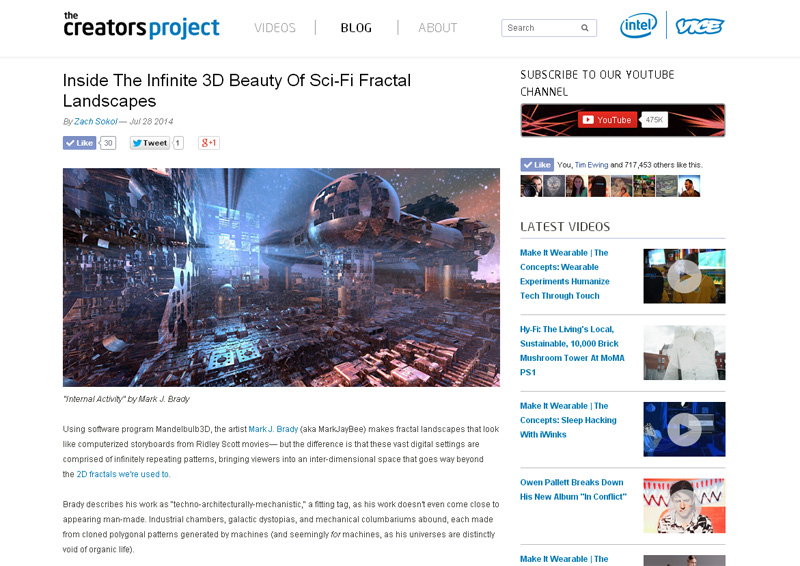
An article about MarkJayBeeFractal has just been published on The Creators Project website. The article was written by Zach Sokol, one of the sites contributors, and showcases some of my more SF oriented work. It also gives some insights into my approach to 3D fractal art, and why I came to use Mandelbulb3D as my 3D fractal tool of choice.
The Creators Project is a global celebration of art and technology.
Founded by a revolutionary partnership between Intel and VICE, The Creators Project celebrates visionary artists across multiple disciplines who are using technology in innovative ways to push the boundaries of creative expression.
They seek to inspire new and emerging artists by showcasing the infinite possibilities presented by the advancement of modern technology. The Creators Project is proud to have showcased more than 500 artists from all around the world.
Launched in 2010, The Creators Project includes daily video and editorial content, an official YouTube Channel, original artwork commissions, and global events. To date, there are more than 500 Creators from around the world. Participating artists include Karen O, M83, Benh Zeitlin, Animal Collective, The xx, Chris Milk, Florence and the Machine, Spike Jonze, Amon Tobin, Matt Pyke, Anthony Wong, Supermarche, United Visual Artists, Sticky Monster Lab, Takeshi Murata, Andrew Huang, Vega Zaishi Wang, Mick Rock, David Bowie and Barney Clay.
So I’m in pretty good company then!
Click the image below to go to the article on The Creators Project site:
Inside the Infinite 3D Beauty of Sci-Fi Fractal Landscapes – The Creators Project
Frac-tal- noun. Origin: French fractale, equivalent to Latin frāctus broken, uneven.
A fractal is a never-ending pattern. Fractals are infinitely complex patterns that are ‘self-similar’ across different scales. They are created by repeating a simple process in an ongoing feedback loop. Driven by recursion, fractals are images of dynamic systems – the pictures of Chaos. Geometrically, they exist in between our familiar dimensions. Fractal patterns are extremely familiar, since nature is full of fractals. Trees, rivers, coastlines, mountains, clouds, seashells, hurricanes, etc are all examples of fractal systems.
Abstract fractals – such as the Mandelbrot Set – can be generated by a computer calculating a simple equation (z = z2 + c) over and over.
The Mandelbrot Set
The Mandelbrot set is a mathematical set of points whose boundary is a distinctive and easily recognizable two -dimensional fractal shape.
The set is closely related to Julia sets (which include similarly complex shapes) and is named after the mathematician Benoit Mandelbrot, who studied and popularized it.
Mandelbrot set images are made by sampling complex numbers and determining for each whether the result tends towards infinity when a particular mathematical operation is iterated on it. Treating the real and imaginary parts of each number as image coordinates, pixels are colored according to how rapidly the sequence diverges, if at all.
For the benefit of those with a more technical nature; the Mandelbrot set is the set of values of c in the complex plane for which the orbit of 0 underiteration of the complex quadratic polynomial:
z_{n+1}=z_n^2+c
remains bounded. That is, a complex number c is part of the Mandelbrot set if, when starting with z0 = 0 and applying the iteration repeatedly, the absolute value of zn remains bounded however large n gets.
For example, letting c = 1 gives the sequence 0, 1, 2, 5, 26,…, which tends to infinity. As this sequence is unbounded, 1 is not an element of the Mandelbrot set. On the other hand, c = −1 gives the sequence 0, −1, 0, −1, 0,…, which is bounded, and so −1 belongs to the Mandelbrot set.
End of ‘technical’ bit…!
Images of the Mandelbrot set display an elaborate boundary that reveals progressively ever-finer recursive detail at increasing magnifications. The ‘style’ of this repeating detail depends on the region of the set being examined. The set’s boundary also incorporates smaller versions of the main shape, so the fractal property of self-similarity applies to the entire set, and not just to its parts.
The Mandelbrot set has become popular outside mathematics both for its aesthetic appeal and as an example of a complex structure arising from the application of simple rules, and is one of the best-known examples of mathematical visualization.
The Quest for the ‘True’ 3D Fractal….
The original Mandelbrot set is of course a remarkable object, and has captured the public imagination for 30 years with its cascading patterns and hypnotically colourful detail.
However, it is still only 2D and flat – there is no sense of depth, no shadows, perspective, or light sourcing. What was sought was a potential 3D version of the same fractal. The search really began with a question posted on FractalForums.com in 2007 by Daniel White (‘twinbee’) regarding this possibility:
“I’m relatively new to fractals, but I have searched for hours to find a true 3D mandlebrot type fractal, all in vain. I don’t want the raised mountain type of Mandlebrot, and I don’t want any true (but trivially simple) ones such as the Menger sponge. I instead want a true 3D equivalent of the Mandlebrot (or near enough). Even if it wasn’t like a 3D rendition of the Mandelbrot, I would love to know of a 3D fractal that has Mandelbrot-type beauty and complexity along with the amazing variety. As far as I know, no such fractal exists, but perhaps I haven’t looked hard enough?”
The article was greeted enthusiastically by members of the forum, and the now classic ‘originating thread’ was born!
The following description is loosely paraphrased from Daniel White’s own account of his part in the search for the 3D Mandelbrot:
Daniels’ initial idea was that instead of rotating around a circle (complex multiplication), as in the normal 2D Mandelbrot, the rotation should be carried out around phi and theta in 3 dimensional spherical coordinates. Theoretically, this would hopefully produce the 3D Mandelbrot. But this was the somewhat disappointing result of the formula:
Mandrt2b by Daniel White
Although this attempt looked somewhat impressive, and had the rough appearance of a 3D Mandelbulb, the ‘real deal’ would be expected to have a level of detail far exceeding it. Perhaps an ‘apple core’ shape with spheres surrounding the perimeter would be a more realistic expectation, with further spheres surrounding those, similar to the way that circles surround circles in the 2D Mandelbrot.
Power2 Mandelbulb by MarkJayBee
Daniel went to great lengths to explore the concept, including the utilization of various spherical coordinate systems and adjusting the rotation of each point’s ‘orbit’ after every half-turn of phi or theta. But it didn’t work. Something was missing. He scoured everywhere to find signs of the 3D beast, but nothing turned up.
Pretty 3D fractals were everywhere, but nothing quite as organic and rich as the original 2D Mandelbrot. The closest turned out to be Dr. Kazushi Ahara and Dr. Yoshiaki’s excellent Quasi-fuchsian fractal, but it turned out that even that didn’t have the variety of the Mandelbrot after zooming in.
Some said it couldn’t be done – that there wasn’t a true analogue to a complex field in three dimensions (which is true), and so there could be no 3D Mandelbrot. But does the essence of the 2D Mandelbrot purely rely on this complex field, or is there something else more fundamental to its form? Eventually, Daniel started to think that this was turning out to be a bit of a Loch Ness hunt. But there was still something at the back of his mind saying if this detail could be found by (essentially) going round and across a circle for the standard 2D Mandelbrot, why couldn’t the same thing be done for a sphere to make a 3D version?
The story continued with mathematician Paul Nylander; in 2009 he had the idea to adjust the squaring part of the formula to a higher power, as was sometimes done with the 2D Mandelbrot to produce ‘snowflake’ type results. Surely this couldn’t work? After all, we’d expect to find sumptuous detail in the standard power 2 (square or quadratic) form, and if it’s not really there, then why should higher powers work?
But maths can behave in odd ways, and intuition plays tricks on you sometimes. Below is an updated version of what he found, and which came to be known as the ‘Mandelbulb‘:
Power8 Mandelbulb by MarkJayBee
Another fractal explorer, computer programmer David Makin was the first to render some sneak preview zooms of the above object, and this is what he found:
Mandelbulb zooms by David Makin
These were deep zoom levels (the first being over 1000x), but fractal details remained abundant in all three dimensions! The buds are growing smaller buds, and at least in the picture on the right, there seems to be a great amount of variety too. We’re seeing ‘branches’ with large buds growing around the branch in at least four directions. These in turn contain smaller buds, which themselves contain yet further tiny buds.
These pictures were not created from an Iterated Function System (IFS), but from a purely simple Mandelbrot-esque function!
The picture on the left is quite interesting, due to it’s similarity to the Romanesco broccoli vegetable. But glance at the top right of the left picture – there also seems to be a leaf section in the shape of a seven sided star. Did this hint at a deeper variety in the object than we can possibly imagine?
Due to the lack of shadows, it was difficult for the renderings to give justice to the detail, but this was a first look into a great unknown….
Following the discovery of the Mandelbulb; in February 2010 FractalForums member Tom Lowe (Tglad) showed his development of the latest, quite spectacular, and more ‘mechanistic’ 3D fractal form, known initially as the ‘Mandelbox’, and later known also as the ‘AmazingBox’. Shown below is a rendering by MarkJayBee of this remarkable object:
Mandelbox scale 2 by MarkJayBee
Subsequent developments in specialised 3D fractal software have allowed for more detailed explorations and renderings – including ‘fly-through’ videos – of 3D fractal objects.
Since those heady days of discovery, a whole range of new 3D fractal formulae have been developed by a number of specialised mathematicians and coders. Coupled with the latest 3D fractal rendering software, this has allowed the creation of an almost infinte range of ‘hybrid’ fractal forms. The scope for artistic creativity using these powerful tools is quite mind-boggling! With the ongoing development of Virtual Reality technology, such as the ‘Oculus Rift‘ headset: the FractalForums.com slogan has it right when it states that: ‘The Possibilities Are Endless‘!!
Below are links to some of the more popular 3D Fractal rendering programs:
Mandelbulb 3D - Created by programmer Jesse Dierks. Currently at version 1.8.9, and available for free download from FractalForums.com. Probably the most popular, flexible and intuitive 3D fractal program. Additional formulae by ‘dark-beam‘ are available by downloading ‘new fmlas.zip‘ from FractalForums.com. Tutorials on getting started with Mandelbulb 3D are available in the ‘Tutorials and Resources’ folder at the ‘mandelbulb3d‘ group on deviantART.
Mandelbulber- Available for free download from SourceForge.net. Mandelbulber is a very powerful 3D fractal rendering program created by Krzysztof Marczak, which allows extremely high resolution images to be rendered. The interface is perhaps not quite as intuitive as that of Mandelbulb 3D, and the program does require a reasonably powerful computer to operate at a decent speed. Currently at version 1.21; although version 2.0 – still in development – promises a more user-friendly interface. A user manual is available here.
Fragmentarium- 3D Fractal program written by Mikael Hvidtfeldt Christensen, also known as ‘Syntopia‘. The program is available for free download. Fragmentarium runs on the computers’ GPU, and thus allows remarkably fast, high resolution renders to be performed, given a sufficiently powerful Graphics Processing Unit.
Incendia- A 3D IFS based fractal generator created by Ramiro Perez or ‘Aexion‘, a 3D programmer based in Spain. Most of the fractals of Incendia are IFS attractors, which are the fastest method for rendering complex 3D fractals. Incendia’s approach to rendering 3D fractals is a straightforward one, since instead of rendering ‘pure’ 3D ‘escapetime’ fractals, it lets the user select different shapes, known as Baseshapes, that in turn converge to the 3D fractal. The basic version of Incendia is free to download. However, to obtain the full high-resolution version, a donation to the website is required.
There are of course many other 3D and 2D fractal programs available; a simple search using the term ’3D fractal software’ will return a host of interesting links.